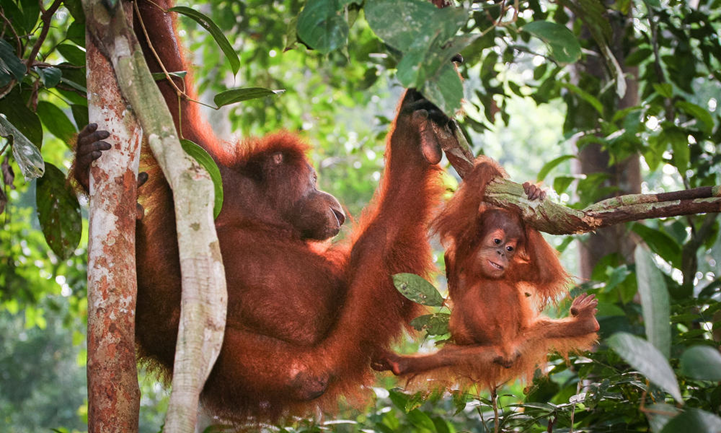
So, what do we already know about are orange fury friends? Firstly, there are three types of Orangutans, the Sumatran Orangutan (Pongo abelii), the Tapanuli Orangutan (Pongo tapanuliensis) and the Bornean Orangutan (Pongo pygmaeus). It is estimated that there are around 104,700 Bornean Orangutans left, 7,500 Sumatran orangutans and only 800 Tapanuli Orangutan. Unfortunately, all three are endangered and have decreasing numbers due to threats such as habitat destruction (World Wildlife Fund, 2020). The question is what kind of action and activities do humans do with Orangutans, and what is the affect their welfare?
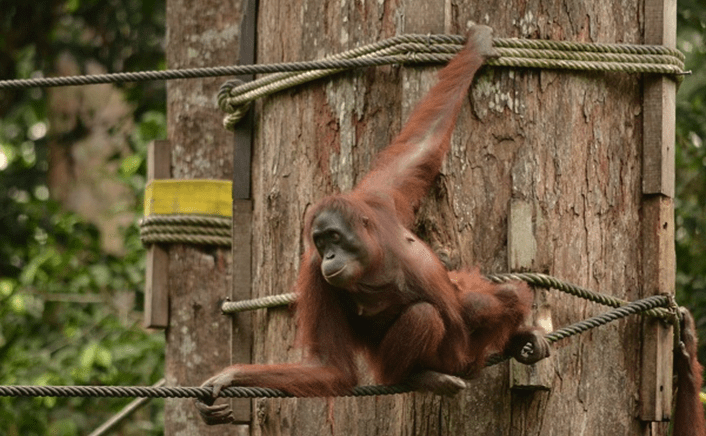
First off what kind of roles do humans play within orangutan’s life’s? Well one way in which humans act when it comes to orangutans is rehabilitation and reintroduction projects. Projects like these have been set up since the 1970s and in 2016 where taking care of around 1,000 displaced and orphaned orangutans across Borne and Sumatra (Russon, Smith & Adams, 2016).
So how do rehabilitation projects have a positive impact on the welfare of orangutans? When it comes to endangered primates such as orangutan’s rehabilitation and conservation projects are common when trying to protect the species. This means that there are high standards when it comes to the practice put in place. In fact, there are best practice guidelines when it comes to the reintroduction of great apes (Guy, Curnoe & Banks, 2013). Through these projects wild orangutans are rescued, rehabilitated and then rereleased into the wild. The projects also preserve and protect the natural habitat which as discussed is extremely important as habitat destruction is the main cause for the decrease in their population. These projects allow for wild orangutans to be protected, stay safe and live happy lives without being subjected to captivity (Wilson, Meijaard, Venter, Ancrenaz & Possingham, 2014).
Another example of human animal interaction with orangutans is a conflict between farmers and the great ape due to crop raiding. As the human population increases the fight for land and space also rises. The problem is humans need the land for resources and lively hood such as farmland. This leads to conflict between orangutans and humans as it has led to crop raiding. The orangutans don’t have much choice as the natural food supply has been affected. They must go onto farmland and take the crops. This has led to a negative impact on their welfare as not only do they have to fight for food, but they are now considered pests. Farmers will actively shoot orangutans to protect their crops if they are witnessed to be trespassing (Campbell-Smith G, Campbell-Smith M, Singleton & Linkie, 2011). The Orangutans in Sumatra would steal or destroy crops on farmers land and as a result the farmers would kill orangutans in retribution. There is ongoing research and projects to help resolve this conflict (Smith, Sembiring & Linkie, 2012).
Hunting is also a big issue with orangutans and humans. In Borneo a study was undertaken between April 2008 and September 2009 where 687 villages where surveyed and it was discovered that the kill rate of orangutans was much higher than expected. Why is the rate so high? Well they study found that most orangutans where killed because of self-defense, for food, traditional medicines and they are considered a pest (Meijaard et al., 2011).
Why is palm oil all over the news? Palm oil is cheaper and more attractive to organizations than rapeseed oil. Palm oil is a multipurpose vegetable oil that can be used in products such as food and biodiesel (Tan, Lee, Mohamed & Bhatia, 2009). Traditionally the main threat to the Orangutan has been massive amounts of logging throughout their environments. Unfortunately, now there is another problem, on top of logging there is now the massive demand in palm oil which has led to mass destruction of habitat (Swarna Nantha & Tisdell, 2008).
Because palm oil has risen so much in demand it is having a devastating effect on Orangutan welfare. Palm oil only grows in tropic climates. This has led to mass deforestation in Indonesia and Malaysia. More and more palm oil plantations are popping up In Sumatra and Borneo, it is thought that 10.8 million hectares of land have been taken up by palm oil plantations. As a result of the deforestation from these plantations the land has chanced due to soil erosion (Orangutan Foundation International, 2019)

So, what does this mean for the Orangutans? Unfortunately, as a result from the land changing the rain forest has become more peat swamp forests meaning that the land is too moist and waterlogged to allow for proper decomposition. The orangutan’s natural habits are being destroyed and changed due to this industry. Once again orangutans are seen as pests as they get in the way of production and sadly abandoned or stray orangutans are often killed (Sumatran Orangutan Society, 2019).
Obviously, zoos are play a huge role in human Orangutan interaction. Zoos hold a unique position where they can educate the public about conservation of a chosen species (Perdue, Stoinski & Maple, 2012).In this cause it improves welfare for Orangutans as it teaches people the impact, they are having on orangutans for example using products with palm oil in. The effect from zoos on the orangutan’s welfare is mainly positive. For starters most zoos must meet regulations for example they have to provide food and water and keep the animals free form injury or disease. As a result, most orangutans have good welfare in captivity as they are provided with good nutrition and receive things such as enrichment (Orangutan Species Survival Plan, 2019).
It really is important not to just focus on the negatives. Yes, human interactions have led to mass destruction of habitat negatively impacting on orangutan’s welfare. However, there are a lot of positive impacts to. Zoos provide a safe space for captive orangutans as well as providing education. The education from zoos means that more people are leaning about the effects they are having and actively changing habits to improve welfare as well as donating to conservation projects. As well as zoos rehabilitation projects are actively trying to save the population and keep the habitat safe and protecting the wild population and allowing for a safe space for orangutans.
References:
About palm oil – SOS – Sumatran Orangutan Society. (2019). Retrieved 9 February 2020, from https://www.orangutans-sos.org/take-action/learn/palm-oil/
Earth Restoration Service. (2018). [Image]. Retrieved from https://www.earthrestorationservice.org/blog/2018/5/16/palm-oil-and-the-threat-to-orangutan-populations
Campbell-Smith G, Campbell-Smith M, Singleton I, Linkie M (2011) Apes in Space: Saving an Imperilled Orangutan Population in Sumatra. PLoS ONE 6(2): e17210. doi:10.1371/journal.pone.0017210
Guy, A., Curnoe, D., & Banks, P. (2013). Welfare based primate rehabilitation as a potential conservation strategy: does it measure up?. Primates, 55(1), 139-147. doi: 10.1007/s10329-013-0386-y
Husbandry. (2019). Retrieved 8 February 2020, from https://www.orangutanssp.org/husbandry.html
Meijaard, E., Buchori, D., Hadiprakarsa, Y., Utami-Atmoko,, S., Nurcahyo, A., & Tjiu, A. et al. (2011). Quantifying Killing of Orangutans and Human-Orangutan Conflict in Kalimantan, Indonesia. Plos ONE, 6(11). doi: 10.1371/journal.pone.0027491
Orangutan | Species | WWF. (2020). Retrieved 3 February 2020, from https://www.worldwildlife.org/species/orangutan
Perdue, B., Stoinski, T., & Maple, T. (2012). Using Technology to Educate Zoo Visitors About Conservation. Visitor Studies, 15(1), 16-27. doi: 10.1080/10645578.2012.660839
Russon, A., Smith, J., & Adams, L. (2016). Ethnoprimatology Primate Conservation in the 21st Century (pp. 233-258). Springer, Cham.
Smith, G., Sembiring, R., & Linkie, M. (2012). Evaluating the effectiveness of human–orangutan conflict mitigation strategies in Sumatra. Journal Of Applied Ecology, Volume 49(Issue no 2), 367-375. doi: https://doi.org/10.1111/j.1365-2664.2012.02109
Swarna Nantha, H., & Tisdell, C. (2008). The orangutan–oil palm conflict: economic constraints and opportunities for conservation. Biodiversity And Conservation, 18(2), 487-502. doi: 10.1007/s10531-008-9512-3
Tan, K., Lee, K., Mohamed, A., & Bhatia, S. (2009). Palm oil: Addressing issues and towards sustainable development. Renewable And Sustainable Energy Reviews, 13(2), 420-427. doi: 10.1016/j.rser.2007.10.001
The Effects of Palm Oil. (2019). Retrieved 6 February 2020, from https://orangutan.org/rainforest/the-effects-of-palm-oil/
The Travel Hack. (2012). [Image]. Retrieved from https://thetravelhack.com/borneo/sepilok-orang-utan-rehabilitation-centre-borneo/
Wilson, H., Meijaard, E., Venter, O., Ancrenaz, M., & Possingham, H. (2014). Conservation Strategies for Orangutans: Reintroduction versus Habitat Preservation and the Benefits of Sustainably Logged Forest. Plos ONE, 9(7). doi: 10.1371/journal.pone.0102174
World Wildlife. (2020). [Image]. Retrieved from https://www.worldwildlife.org/stories/endangered-species-threatened-by-unsustainable-palm-oil-production
Follow My Blog
Get new content delivered directly to your inbox.
 Orangutan welfare: Is orange really the new black?